Your company is thriving.Why isn't it getting easier?
More questions. More alignment. More decisions that ultimately land back on your desk.
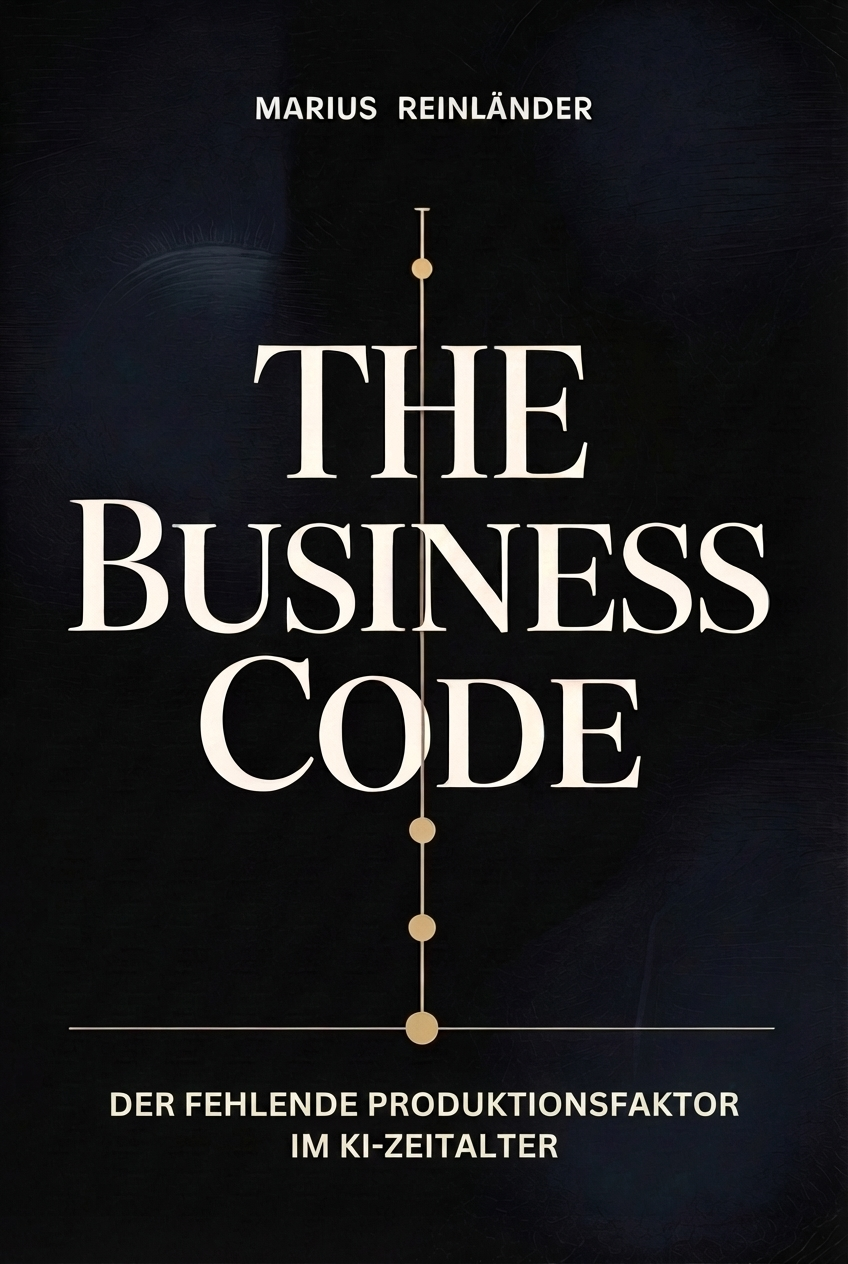
THE BUSINESS CODE examines why growing complexity makes organizations harder to control – and why the cause is rarely lack of technology or effort.
A book on mental capacity, decision-making, and organization in the AI era.
23:57
An entrepreneur sits at the kitchen table.
The day is over. The company is operating.
But in their head, nothing is finished.
A client is waiting for a call. An employee needs a decision. A project has grown more expensive than planned.
And somewhere in this mix of responsibility and open loops stands a quiet question:
Why does this company feel heavier than it used to?
Many entrepreneurs know this moment.
Decisions that should happen in the system return to the top.
Modern companies do not just produce products.
They produce decisions.
Every meeting.
Every alignment.
Every approval.
Is part of a decision system.
No single decision is the problem. The pattern is.
Perhaps this is not a personal failure.
Perhaps it is not simply too much work.
When the same questions, approvals, and alignments repeatedly land in the same places, burden turns into a structural pattern.
That is where the question of mental capacity begins.
Of course a company can be understaffed.
Of course technology can be missing.
And growth genuinely generates complexity.
The decisive question is not whether these factors exist. But how much of them should land on your desk.
Internet, Smartphones, Social Media, Cloud, AI
The capacity of the human nervous system to cope with this condensation does not grow at the same pace.
The Complexity Gap.
Mental Capacity
The ability to separate relevant from irrelevant information, maintain priorities, and decide clearly under uncertainty is limited.
The more unresolved decisions an organization throws back to individuals, the more of this capacity it consumes.
Mental capacity directly influences how effectively capital, labor, and technology translate into performance.
Effort does not replace architecture.
Personal effort can compensate for lack of clarity for a long time. But it does not solve it structurally.
The Business Code
Every company has an inner decision logic:
Who decides what?
What can happen without approval?
When must something escalate?
The book calls this decision architecture the Business Code.
Reality
Market, clients, numbers, friction, change
Nervous System
Attention, perception, prioritization, mental capacity
Decisions
Selection, evaluation, trade-offs, responsibility
Organization
Roles, rules, interfaces, escalation logic
Impact
Speed, productivity, innovation, relief, growth
Technology amplifies systems. It does not replace them.
AI can make clear organizations more productive. It can also accelerate chaos in unclear ones.

Marius Reinländer
As an expert in organizational architecture, Marius Reinländer witnesses daily where companies truly fail: not due to lack of technology, but lack of clarity in their decision systems.
With the Business Code, he developed a framework that decodes the invisible architecture of organizations and examines how mental capacity becomes the bottleneck of value creation.
Answers to your questions
You might recognize the pattern.
The company is working.
But more and more decisions, questions, and open loops remain stuck on the same individuals.
The sample chapter begins right there: at a kitchen table, at 23:57.